Selling · Co-ownership · special assessment 2027
The Civil Code rule, the calculation in three steps, a table of examples by total assessment and by the condo's share of the building, then what 12 or 24 instalments look like.
Your portion of a special assessment is calculated by multiplying the total amount of the assessment by your condo's share of the building, that is, the relative value of your fraction (article 1064 of the Civil Code of Québec). Example: on a total assessment of $500,000, a condo with a 2% share pays $10,000. Your share is found in the declaration of co-ownership. Payment in several instalments depends on the syndicate's notice: nothing in the law guarantees that the payments can be spread out. Sources: Civil Code of Québec and OACIQ, read on November 24, 2026.
The short answer
Your portion of a special assessment is calculated by multiplying the total amount of the assessment by your condo's share of the building, that is, the relative value of your fraction (article 1064 of the Civil Code of Québec). Example: on a total assessment of $500,000, a condo with a 2% share pays $10,000. Your share is found in the declaration of co-ownership. Payment in several instalments depends on the syndicate's notice: nothing in the law guarantees that the payments can be spread out.
The rule: in proportion to the relative value of your fraction
Article 1064 of the Civil Code of Québec sets the rule: each co-owner contributes to the common expenses in proportion to the relative value of that co-owner's fraction. The fraction is the Code's word for your condo. Its relative value, commonly called your share of the building, is the part of the building attached to it, expressed here as a percentage.
The consequence: in the same building, not all co-owners pay the same amount. A condo with a share twice as large pays twice as much.
The calculation in three steps
- Find the total amount of the special assessment decided by the syndicate.
- Find your condo's share of the building in the declaration of co-ownership.
- Multiply one by the other: $500,000 × 2% = $10,000.
In practice, the syndicate's notice already gives you the result: it states the amount of your contribution and the date it is due. The calculation is used to check it, or to estimate your portion before the notice arrives.
Table: your portion by total and by share of the building
| Condo's share of the building | Total assessment of $200,000 | Total assessment of $500,000 | Total assessment of $1,000,000 |
|---|---|---|---|
| 1% | $2,000 | $5,000 | $10,000 |
| 2% | $4,000 | $10,000 | $20,000 |
| 3% | $6,000 | $15,000 | $30,000 |
| 5% | $10,000 | $25,000 | $50,000 |
Calculation examples only: total amount × share of the building. These are not averages. Each building has its own amount, and each condo its own share.
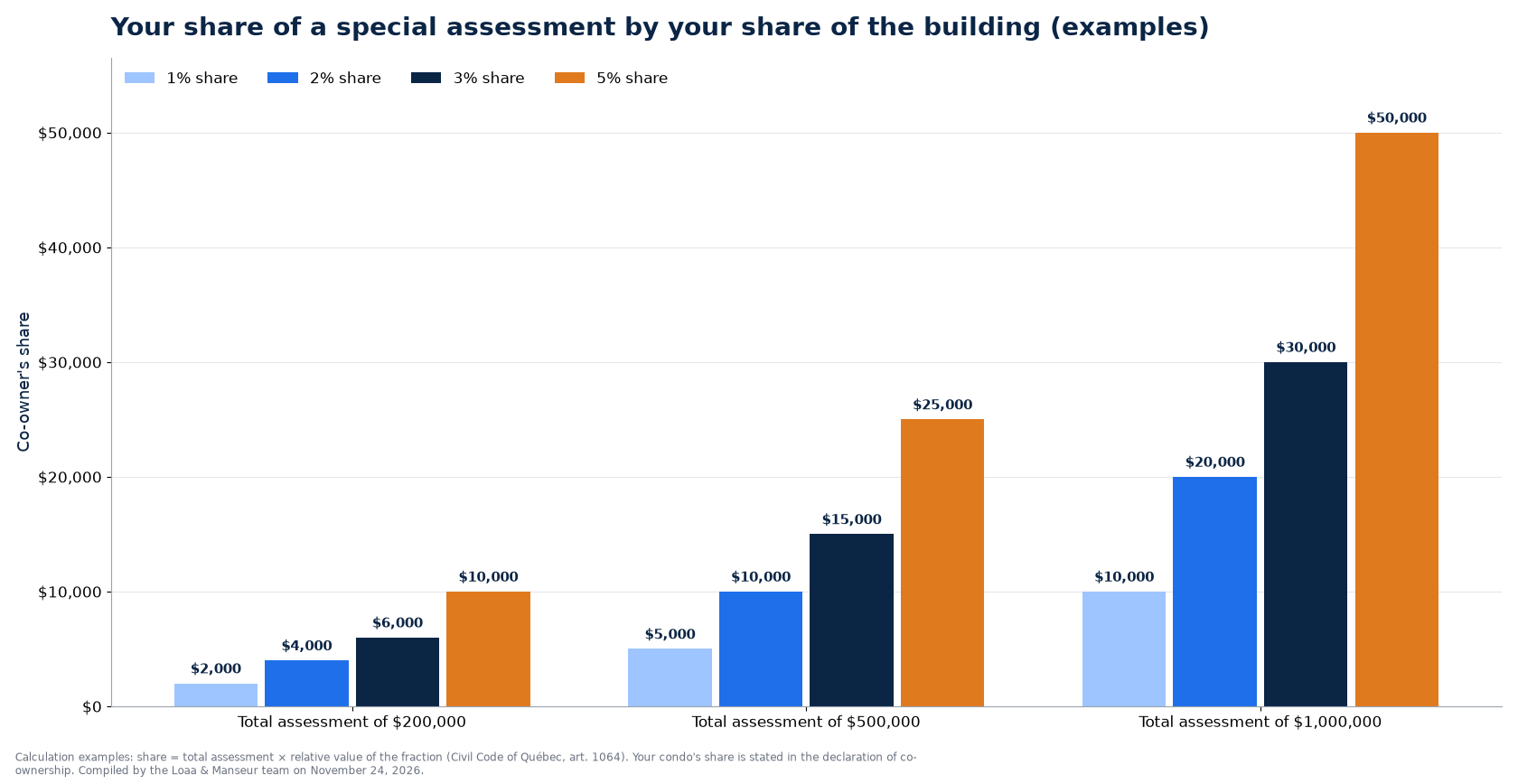
In these examples, the portion ranges from $2,000 (a 1% share of a $200,000 assessment) to $50,000 (a 5% share of a $1,000,000 assessment). The same total therefore weighs very differently from one condo to another.
If the syndicate allows instalments
When the syndicate allows payment in several instalments, the portion is divided by the number of instalments. The terms of the syndicate's notice decide: nothing in the law guarantees that the payments can be spread out.
| Your portion | In 12 instalments | In 24 instalments |
|---|---|---|
| $2,000 | $167 | $83 |
| $4,000 | $333 | $167 |
| $5,000 | $417 | $208 |
| $6,000 | $500 | $250 |
| $10,000 | $833 | $417 |
| $15,000 | $1,250 | $625 |
| $20,000 | $1,667 | $833 |
| $25,000 | $2,083 | $1,042 |
| $30,000 | $2,500 | $1,250 |
| $50,000 | $4,167 | $2,083 |
Simple division of the portion into 12 or 24 equal instalments, rounded to the dollar. The actual terms are those in your syndicate's notice.
The exception: common portions for restricted use
The same article 1064 adds that the co-owners who have the use of common portions for restricted use contribute alone to the expenses related to the maintenance and routine repairs of those portions. A common portion for restricted use is a common portion that only certain co-owners have the use of. For its maintenance and routine repairs, they alone pay.
For the major repairs and the replacement of these portions, the declaration of co-ownership can provide for a different apportionment. So that is the document to read when an assessment covers this kind of work.
Improvement work: an apportionment decided at the meeting
When the assessment finances work to alter, enlarge or improve the common portions, the decision is made at the meeting of the co-owners, by three-quarters of the votes of the co-owners present or represented (article 1097). That vote also covers the apportionment of the cost of the work. Who decides what, and how to contest: contesting a special assessment.
Where to find your share and how to check the notice
Your share appears in the building's declaration of co-ownership: see what a declaration of co-ownership contains. To check the syndicate's notice, divide your portion by the total amount of the assessment: the result should match your share.
If it does not, there are three possible explanations: the assessment covers a common portion for restricted use, the declaration of co-ownership provides for a different apportionment for this work, or there is an error. Ask the syndicate for the details of the calculation.
Why an assessment rather than the contingency fund
According to the OACIQ, special assessments are the source of financing when the syndicate does not have the required funds: for example for major or replacement work when the contingency fund is not enough. The fund itself is allocated solely to the major repairs and the replacement of the common portions (article 1071). To go further: the contingency fund in a co-ownership.
Are you selling or buying?
The calculation gives the amount, not the person who pays it. Between a seller and a buyer, the due date decides in principle: see who pays the special assessment, the seller or the buyer and selling a condo with a special assessment. This page informs you and is not legal advice: for a disagreement over the apportionment, see your notary or a co-ownership lawyer.
Frequently asked questions
How do I calculate my portion of a special assessment?
Multiply the total amount of the assessment by your condo's share of the building. On an assessment of $200,000, a 3% share gives $6,000.
Do all co-owners pay the same amount?
No. Each one contributes in proportion to the relative value of that co-owner's fraction (article 1064 of the Civil Code of Québec): the larger the condo's share, the higher the portion to pay.
Does the syndicate have to accept payment in instalments?
Nothing in the law guarantees that the payments can be spread out. The terms of the syndicate's notice decide: the amount, the due date and, where applicable, the instalments.
Where do I find my condo's share of the building?
In the building's declaration of co-ownership. Then compare it with the syndicate's notice to check your portion.
Can a special assessment be apportioned other than by shares of the building?
Yes, in some cases: the expenses for the maintenance and routine repairs of common portions for restricted use are paid by those who have the use of them, and the declaration of co-ownership can provide for a different apportionment for their major repairs and their replacement.
Sources: Civil Code of Québec, articles 1064, 1071, 1072 and 1097 (LégisQuébec, updated to October 15, 2026); OACIQ, professional practices guide, Divided co-ownership, section 7.3 on special assessments. Read on November 24, 2026.
Our proof, not our promises
The Loaa & Manseur team, led by Lotfi Manseur and Loaa Al Daow, is the number 1 team at RE/MAX Platine in 2024 and 2025, 6th RE/MAX team in Quebec, 15th in Canada and in the global top 50 of large residential teams according to the official RE/MAX ranking, computed on actual transactions. Its Google profile counts more than 220 reviews with a 4.9 rating. Its offices are at 55 avenue de l'Équinoxe in Brossard, one bridge from the island, and every broker's licence can be checked in the OACIQ public register. Three things to verify yourself before calling us, and to demand of any other broker.
Also available in French: version française de ce guide.
Published September 7, 2026 by the Loaa & Manseur team, the number 1 team at RE/MAX Platine in 2024 and 2025, 6th RE/MAX team in Quebec, 15th in Canada and in the global top 50 according to the official RE/MAX ranking. Tell us about your project.