Buying · Co-ownership · special assessment 2027
A special assessment that becomes due after your purchase is in principle yours. Here are the documents to request, the questions to ask, the signs to spot and the clauses that protect you before signing.
Before signing, ask in writing whether a special assessment has been decided or is coming: in principle, one that becomes due after your purchase falls to you, unless agreed otherwise. Do not rely on a single document, because the certificate of the syndicate has no line titled "special assessment". Also ask for the DRCOP form, the statement of common expenses under article 1069 of the Civil Code of Québec, the latest contingency fund study and the list of work planned over 10 years. Have the promise to purchase state who pays the assessment. And count it in your budget: it is not part of the mortgage loan and is generally paid out of pocket. Sources: Civil Code of Québec, Société d'habitation du Québec, OACIQ and Condolegal.com, read on November 24, 2026.
The short answer
Before signing, ask in writing whether a special assessment has been decided or is coming: in principle, one that becomes due after your purchase falls to you, unless agreed otherwise. Do not rely on a single document, because the certificate of the syndicate has no line titled "special assessment". Also ask for the DRCOP form, the statement of common expenses under article 1069 of the Civil Code of Québec, the latest contingency fund study and the list of work planned over 10 years. Have the promise to purchase state who pays the assessment. And count it in your budget: it is not part of the mortgage loan and is generally paid out of pocket.
Why check before signing
Two rules work against a buyer who does not ask questions. The first: common expenses are payable by whoever is the owner when they become due. An assessment decided before your purchase, but due after it, therefore falls to you in principle. The second: under article 1069 of the Civil Code of Québec, the buyer of a condo is liable for paying, with interest, the common expenses due at the time of the acquisition. So you can inherit an assessment the seller did not pay. The split, situation by situation: who pays the special assessment, the seller or the buyer.
The documents to request
| Document | Who gives it to you | What you look for in it |
|---|---|---|
| Certificate of the syndicate on the state of the co-ownership | The seller, who gets it from the syndicate within 15 days of the request | The contingency fund compared with the amount recommended by the study, and the major repairs planned in the next 10 years with their estimated cost |
| Declarations by the seller of the immovable (divided co-ownership) | The seller, through the broker | Clause D14.10 on the special assessment and the details in section D15 |
| DRCOP form (Request for information to the syndicate of co-owners) | The brokers on the file | Arrears of common expenses, future assessments to expect, the contingency fund balance and legal proceedings under way |
| Statement of the common expenses due (article 1069) | The syndicate, at your request or your notary's | What the seller still owes. If the syndicate does not answer within 15 days, you are not liable for those expenses |
| Latest contingency fund study | The seller or the syndicate | The amounts recommended for the fund and the sums to be paid into it each year |
| Other syndicate documents (article 1068.2), for example meeting minutes | The syndicate, at your expense | Whether the board has consulted the meeting of the co-owners on an upcoming assessment |
Article 1068.2 allows a buyer who has signed a promise to purchase to ask the syndicate for the documents or information about the building and the syndicate that would allow the buyer to give informed consent. The syndicate must provide them diligently, at the buyer's expense. Since the board must consult the meeting of the co-owners before deciding on a special assessment, the documents from the latest meetings are worth reading.
The questions to ask in writing
- Has a special assessment been decided? For what total amount, and what is this condo's portion?
- On what date is it due? Is it payable in instalments?
- Has the board of directors consulted the meeting of the co-owners on an upcoming assessment?
- Which major repairs and replacements are planned in the next 10 years, and at what estimated cost?
- Does the contingency fund reach the amount recommended by the study? Have the study and the maintenance log been done?
- Are there any disputes under way?
According to Condolegal, before signing at the notary's office, the buyer or the buyer's notary asks the syndicate for three things: the statement of expenses owed by the seller, the amount of the expenses established before the sale but whose payment is requested after it, and the statement of calls for funds calculated before the sale.
The signs that an assessment may be coming
- A contingency fund below the amount recommended by the study.
- Major repairs planned soon, with an estimated cost higher than what the fund holds.
- No contingency fund study yet: syndicates have until August 15, 2028 to obtain it, and a first study can show that the fund is insufficient.
- Little cash or deficits in the latest financial statements: according to the OACIQ, a special assessment is also used to pay for maintenance, repairs or an insurance deductible when the operating account is not enough.
No sign on this list proves that an assessment will be decided. They only tell you where to ask questions. To read the certificate line by line: the syndicate certificate and special assessments. To understand the fund: the contingency fund in a co-ownership.
How to protect yourself in the promise to purchase
- The DRCOP condition: if the form is not available, the OACIQ says the buyer's broker should recommend that the promise to purchase be conditional on obtaining it.
- Who pays the known assessment: a price reduction, an amount held back at the notary's office, or a reimbursement by the seller at the time of the sale.
- An apportionment date for the expenses: often the transfer of ownership or the possession date.
- Urgent work to be done before the sale: to be settled clearly in the promise.
- The statement of expenses under article 1069: ask for it early, the syndicate has 15 days to provide it.
This page informs you and is not legal advice: for your situation, see your notary or a co-ownership lawyer.
The effect on your budget
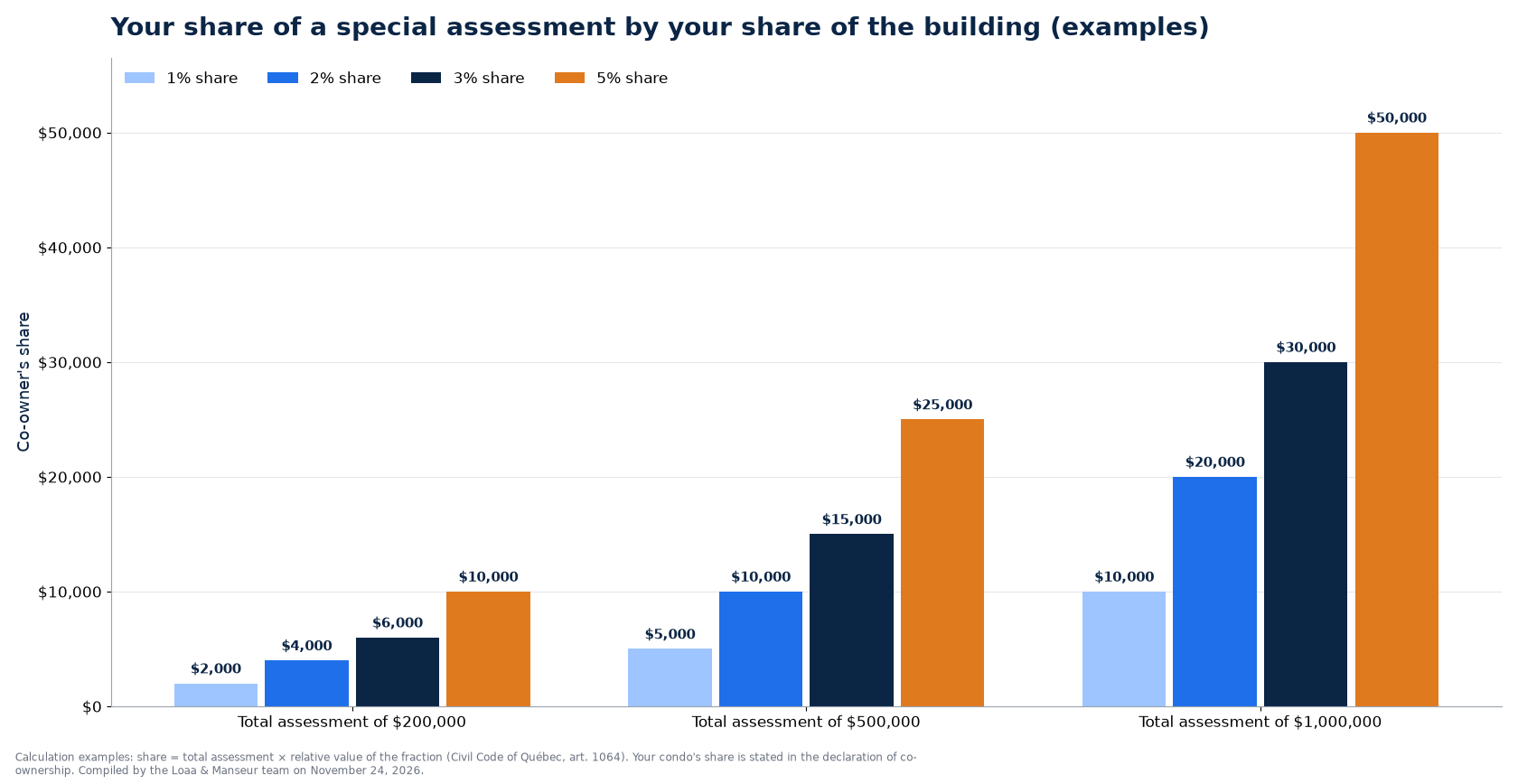
An assessment of $10,000 payable after the purchase amounts to paying $10,000 more for the condo, without the mortgage loan covering it: it is generally paid out of pocket, unless there is an agreement with the seller.
To estimate the amount, you need two figures: the total of the assessment and the condo's share of the building, that is, the part of the building attached to it. For example, on a total assessment of $500,000, a condo with a 2% share owes $10,000; with a 5% share, $25,000. The full table: calculating a special assessment by share of the building. For the rest of a condo budget: condo fees in Quebec and the co-ownership buyer guide.
If the seller told you nothing
The seller must disclose an imminent special assessment or upcoming work the seller knows about. According to Condolegal, courts have already ordered sellers to reimburse special assessments to their buyer, as damages. If you discover after the purchase an assessment the seller knew about, talk to a lawyer without delay.
Frequently asked questions
Should you avoid a condo that has a special assessment?
Not necessarily. A special assessment finances an expense the syndicate cannot pay with the funds it has. What matters is knowing the amount and the due date before signing, and taking it into account in the price or in the promise to purchase.
Does the mortgage loan cover a special assessment?
No: an assessment payable after the purchase is not part of the loan. It is generally paid out of pocket, unless there is an agreement with the seller, for example a price reduction or an amount held back at the notary's office.
Am I responsible for the assessments the seller did not pay?
You can be: the buyer is liable for the common expenses due at the time of the acquisition (article 1069). Ask the syndicate for a statement of the expenses: if it does not provide it within 15 days, you are not liable for them.
Does the syndicate have to answer my questions?
Article 1068.2 of the Civil Code of Québec provides that the syndicate provides diligently, at the expense of the buyer who has signed a promise to purchase, the documents or information that allow the buyer to give informed consent.
Sources: Civil Code of Québec, articles 1068.1, 1068.2, 1069 and 1072.1 (LégisQuébec, updated to October 15, 2026); Société d'habitation du Québec, explanatory guide to the regulation establishing various rules for divided co-ownership (August 2025) and model certificate of the syndicate; OACIQ, professional practices guide, Divided co-ownership, section 7.3 on special assessments; Condolegal.com, fact sheet on the apportionment of common expenses between seller and buyer. Read on November 24, 2026.
Our proof, not our promises
The Loaa & Manseur team, led by Lotfi Manseur and Loaa Al Daow, is the number 1 team at RE/MAX Platine in 2024 and 2025, 6th RE/MAX team in Quebec, 15th in Canada and in the global top 50 of large residential teams according to the official RE/MAX ranking, computed on actual transactions. Its Google profile counts more than 220 reviews with a 4.9 rating. Its offices are at 55 avenue de l'Équinoxe in Brossard, one bridge from the island, and every broker's licence can be checked in the OACIQ public register. Three things to verify yourself before calling us, and to demand of any other broker.
Also available in French: version française de ce guide.
Published September 7, 2026 by the Loaa & Manseur team, the number 1 team at RE/MAX Platine in 2024 and 2025, 6th RE/MAX team in Quebec, 15th in Canada and in the global top 50 according to the official RE/MAX ranking. Tell us about your project.