Buying · Ottawa or Gatineau · cost of living
Gatineau and Ottawa face each other across the river, but two provinces set the rates. Daycare, electricity, driving, transit, sales tax, income tax and prescription drugs: here is what the official 2026 figures say, item by item, with no artificial total.
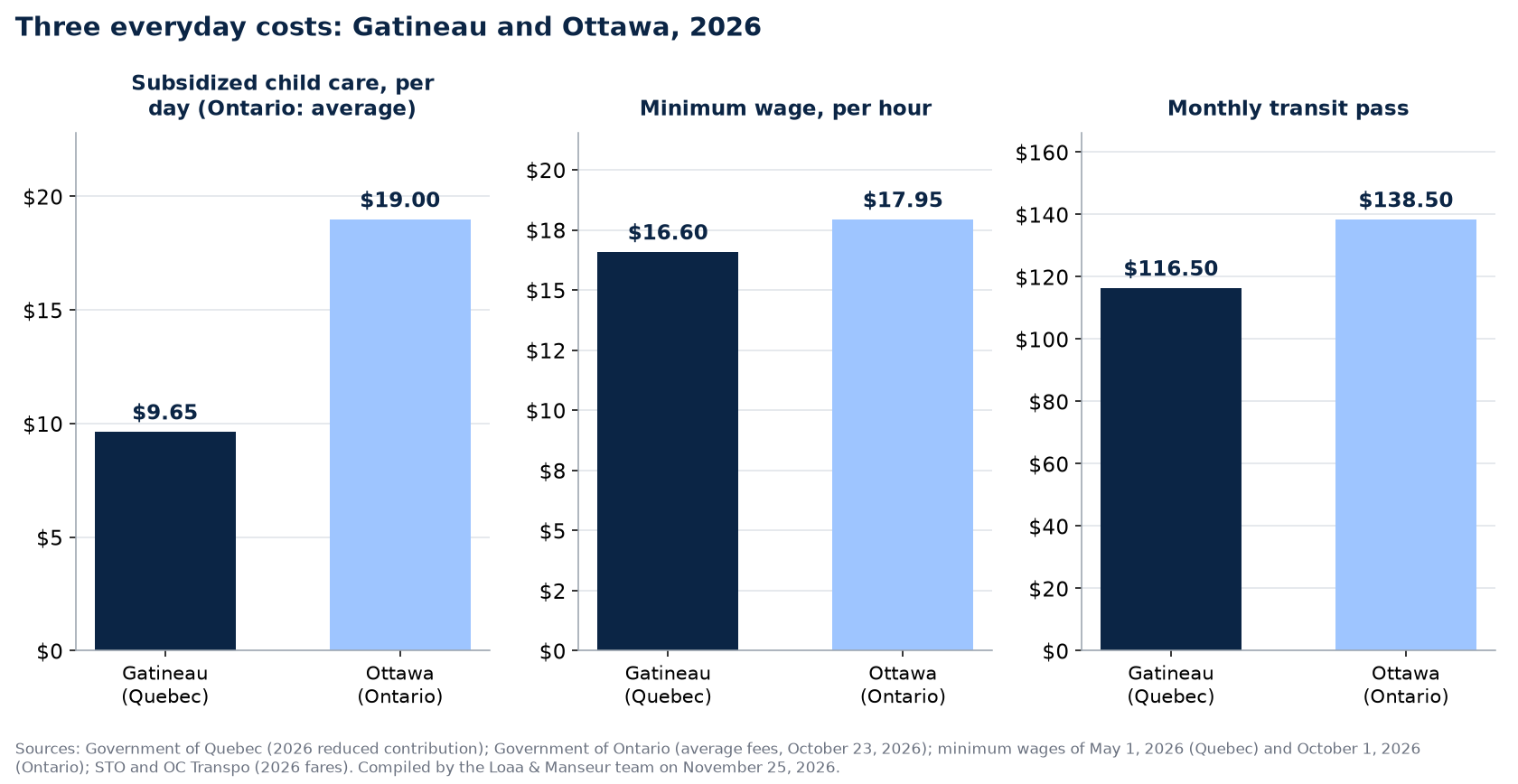
In 2026, a subsidized daycare space costs $9.65 per day in Quebec (Ministère de la Famille), against a cap of $22 and an average of $19 in Ontario (ontario.ca). A monthly transit pass costs $116.50 at the STO and $138.50 at OC Transpo. The median price of a single-family home is $490,000 in Gatineau (Centris) and $749,950 in Ottawa (OREB, October 2026). In the other direction, income tax is higher in Quebec, and the minimum wage there is $16.60 an hour, against $17.95 in Ontario. These items cannot be added up.
The short answer
In 2026, a subsidized daycare space costs $9.65 per day in Quebec (Ministère de la Famille), against a cap of $22 and an average of $19 in Ontario (ontario.ca). A monthly transit pass costs $116.50 at the STO and $138.50 at OC Transpo. The median price of a single-family home is $490,000 in Gatineau (Centris) and $749,950 in Ottawa (OREB, October 2026). In the other direction, income tax is higher in Quebec, and the minimum wage there is $16.60 an hour, against $17.95 in Ontario. These items cannot be added up.
Housing: a reminder of prices and rents
From January 1 to September 16, 2026, the median price in Gatineau is $490,000 for a single-family home and $303,750 for a condo (Centris, data compiled by our team). For October 2026, the Ottawa Real Estate Board (OREB) reports a median sale price of $749,950 for a single-family home and $375,000 for a condo. For Ottawa rents, Rentals.ca and Urbanation report an average asking rent in October 2026 of $1,967 for a one-bedroom and $2,469 for a two-bedroom. Our sources contain no comparable rent for Gatineau.
Daycare: a flat rate in Quebec, a cap in Ontario
In Quebec, the reduced contribution for a subsidized space is $9.65 per day until December 31, 2026. According to the Ministère de la Famille's 2026-2027 budget rules, it will go to $10.60 per day on January 1, 2027, or $0.95 more. That amount is announced subject to the indexation published in the Gazette officielle.
For a non-subsidized space, the refundable tax credit for childcare expenses covers 67% to 78% of eligible expenses in 2026, depending on family income, up to $12,525 of expenses per child under 7 (Ministère des Finances du Québec, 2026 parameters).
The rate does not guarantee a space. As of August 31, 2026, the Ministère de la Famille's dashboard counts 320,125 spaces in Quebec and 30,688 children waiting whose space was wanted before May 31, 2025. These are province-wide figures: nothing specific to Gatineau was found.
In Ontario, licensed child care providers enrolled in the Canada-wide program have capped their fees at $22 per day since January 1, 2025, for children aged 0 to 5. The provincial average is $19 per day (ontario.ca, page updated October 23, 2026). In June 2026, 93% of licensed spaces for that age group were with enrolled providers. No official figure was found for Ottawa's waitlist.
Electricity: two ways of billing
In Gatineau, Hydro-Québec's Rate D in effect on April 1, 2026 includes a system access charge of 46.154¢ per day, then 7.065¢ per kilowatt-hour for the first 40 kilowatt-hours per day and 11.142¢ beyond that, before taxes.
In Ottawa, the regulated prices announced by the Ontario Energy Board for November 1, 2026 vary by time of day: 9.1¢ per kilowatt-hour off-peak, 14.6¢ mid-peak and 18.9¢ on-peak. The tiered option is 11.2¢ up to 1,000 kilowatt-hours per month in winter, then 13.2¢. Hydro Ottawa's delivery charges are added, and the Ontario Electricity Rebate takes 15.7% off the bill before tax.
The only official sample bill available comes from Hydro-Québec's price comparison, 2025 edition, at rates in effect on April 1, 2025. For 1,000 kilowatt-hours per month, it shows $82.90 in Montréal and $143.51 in Ottawa, before taxes. The city compared is Montréal, not Gatineau, where the same Rate D applies. The table does not say whether the Ontario rebate is deducted.
Driving and public transit
In Quebec, the SAAQ's public plan covers injuries suffered in a road accident. Its insurance contribution is collected with the driver's licence and the vehicle registration. According to the SAAQ, in 2026:
- renewing a Class 5 licence costs $50.23 with no demerit points, after a 75% saving on the insurance contribution; the regular cost is $120.67;
- registering a passenger vehicle costs $217.41, or $247.41 in a municipality served by public transit, including $71.96 of insurance contribution;
- in Gatineau, a vehicle registration tax has been added since January 1, 2025; its amount was not found at the source.
In Ontario, auto insurance is private. The average annual premium is $2,218 province-wide and $2,131 in the "other urban" category (FSRA, June 2026 data); there is no figure specific to Ottawa. One caveat: that premium covers both injuries and property damage, while the SAAQ contribution covers injuries only. In Quebec, property damage is handled by a private insurer, whose average premium is not in our sources.
On public transit, the regular monthly pass costs $116.50 at the STO (fares of January 1, 2026) and $138.50 for an adult at OC Transpo (fares of July 1, 2026), or $22 more in Ottawa. For January 1, 2027, the STO is proposing $120.00, a 3% increase to be confirmed when the budget is adopted.
Sales tax, minimum wage and income tax
According to the CRA (2026), Ontario charges 13% HST; Quebec charges 5% GST and 9.975% QST. The general minimum wage is $17.95 an hour in Ontario since October 1, 2026 (ontario.ca) and $16.60 in Quebec since May 1, 2026 (CNESST), or $1.35 more in Ontario.
Income tax points the other way. According to Raymond Chabot Grant Thornton's 2026 tax tables, at $60,000 of taxable income, total income tax is $11,200 for a Quebec resident and $8,818 for an Ontario resident, or $2,382 more in Quebec. At $100,000, it is $25,647 versus $20,771, or $4,876 more. These tables are for a single person with only the basic personal credit; they exclude payroll contributions and do not appear to include the Ontario Health Premium.
Health care and prescription drugs
Quebec has a public prescription drug insurance plan, with its own rates. From July 1, 2026 to June 30, 2027, according to the RAMQ, the annual premium ranges from $0 to $789 depending on net family income and is paid through the Quebec income tax return. On top of that come a monthly deductible of $21.25 and 30% co-insurance; the maximum contribution is $105.25 per month, or $1,263 per year. Ontario's drug plan is not covered in our sources, so no comparison is made here.
For someone arriving from another province, RAMQ coverage starts after a waiting period of up to three months; until then, the province of origin keeps covering care. Ontario states that its health insurance plan has no waiting period.
How to read these numbers
- No total basket and no ranking: the items cannot be added up, for lack of comparable data.
- Housing: the price periods differ, and Rentals.ca rents are asking rents.
- Daycare: $9.65 is a flat rate, $22 a cap and $19 an average. Whether Ontario's cap stays in place after December 31, 2026 was not confirmed at an official source.
- Electricity: no official sample bill at 2026 rates for Gatineau and Ottawa; we do not calculate a bill from the rate schedules.
- Driving: the average premium specific to Ottawa and Quebec's average private premium are missing.
For your own situation, speak with an accountant or the organization concerned (Revenu Québec, RAMQ, SAAQ).
The other pages in this series: Ottawa or Gatineau: where to buy, home prices, Ottawa vs Gatineau, income tax, Quebec vs Ontario, property tax and welcome tax, living in Gatineau and working in Ottawa. See also: houses for sale in Gatineau, Gatineau property taxes in 2026, home prices in Aylmer, the Aylmer market, quarter by quarter, moving from Ontario to Quebec, Montréal vs Ottawa.
Frequently asked questions
Is the cost of living lower in Gatineau than in Ottawa?
It depends on the household. In 2026, the median home price, subsidized daycare and the transit pass are lower in Gatineau; income tax is higher there and the minimum wage is lower. For lack of comparable data, we do not calculate a total.
How much does daycare cost in Gatineau and in Ottawa?
According to the Ministère de la Famille, a subsidized space costs $9.65 per day in Quebec in 2026; $10.60 is announced for January 1, 2027, subject to confirmation. In Ontario, according to ontario.ca, providers enrolled in the Canada-wide program cap their fees at $22 per day, with a provincial average of $19.
Is electricity cheaper in Gatineau than in Ottawa?
The only official example dates from 2025 and compares Montréal with Ottawa: $82.90 versus $143.51 per month for 1,000 kilowatt-hours, before taxes, according to Hydro-Québec. Gatineau has the same Rate D as Montréal. No example at 2026 rates was found.
Is car insurance cheaper in Quebec than in Ontario?
The available figures do not settle it. Ontario's average premium of $2,218 per year (FSRA, June 2026) covers both injuries and property damage. In Quebec, the SAAQ covers injuries only, and the average private premium is not in our sources.
Sources: Centris (data compiled by the team, January 1 to September 16, 2026); OREB (October 2026 report); Rentals.ca and Urbanation (November 2026 report); Ministère de la Famille (2026-2027 budget rules; dashboard as of August 31, 2026); Ministère des Finances du Québec (2026 parameters); Ontario (child care agreement, October 23, 2026; minimum wage; health insurance); Hydro-Québec (rates of April 1, 2026; price comparison, 2025 edition); Ontario Energy Board (news release of October 16, 2026); Hydro Ottawa; SAAQ (2026 insurance contributions); FSRA (June 2026); STO (2026 fares; 2027 budget forecast of November 3, 2026); OC Transpo (fares of July 1, 2026); CRA (2026 rates); CNESST; Raymond Chabot Grant Thornton (2026 tax tables, April 30, 2026); RAMQ (rates of July 1, 2026). Figures collected on November 25, 2026.
Our proof, not our promises
The Loaa & Manseur team, led by Lotfi Manseur and Loaa Al Daow, is the number 1 team at RE/MAX Platine in 2024 and 2025, 6th RE/MAX team in Quebec, 15th in Canada and in the global top 50 of large residential teams according to the official RE/MAX ranking, computed on actual transactions. Its Google profile counts more than 220 reviews with a 4.9 rating. Its offices are at 55 avenue de l'Équinoxe in Brossard, one bridge from the island, and every broker's licence can be checked in the OACIQ public register. Three things to verify yourself before calling us, and to demand of any other broker.
Also available in French: version française de ce guide.
Published September 7, 2026 by the Loaa & Manseur team, the number 1 team at RE/MAX Platine in 2024 and 2025, 6th RE/MAX team in Quebec, 15th in Canada and in the global top 50 according to the official RE/MAX ranking. Tell us about your project.