Buying · Ottawa or Gatineau · taxes and buying costs
Buying in Gatineau or in Ottawa does not mean paying the same transfer tax or the same municipal taxes. Here are the 2026 rate schedules, the tax bills each city publishes, what is proposed for 2027 and the buying rules that differ.
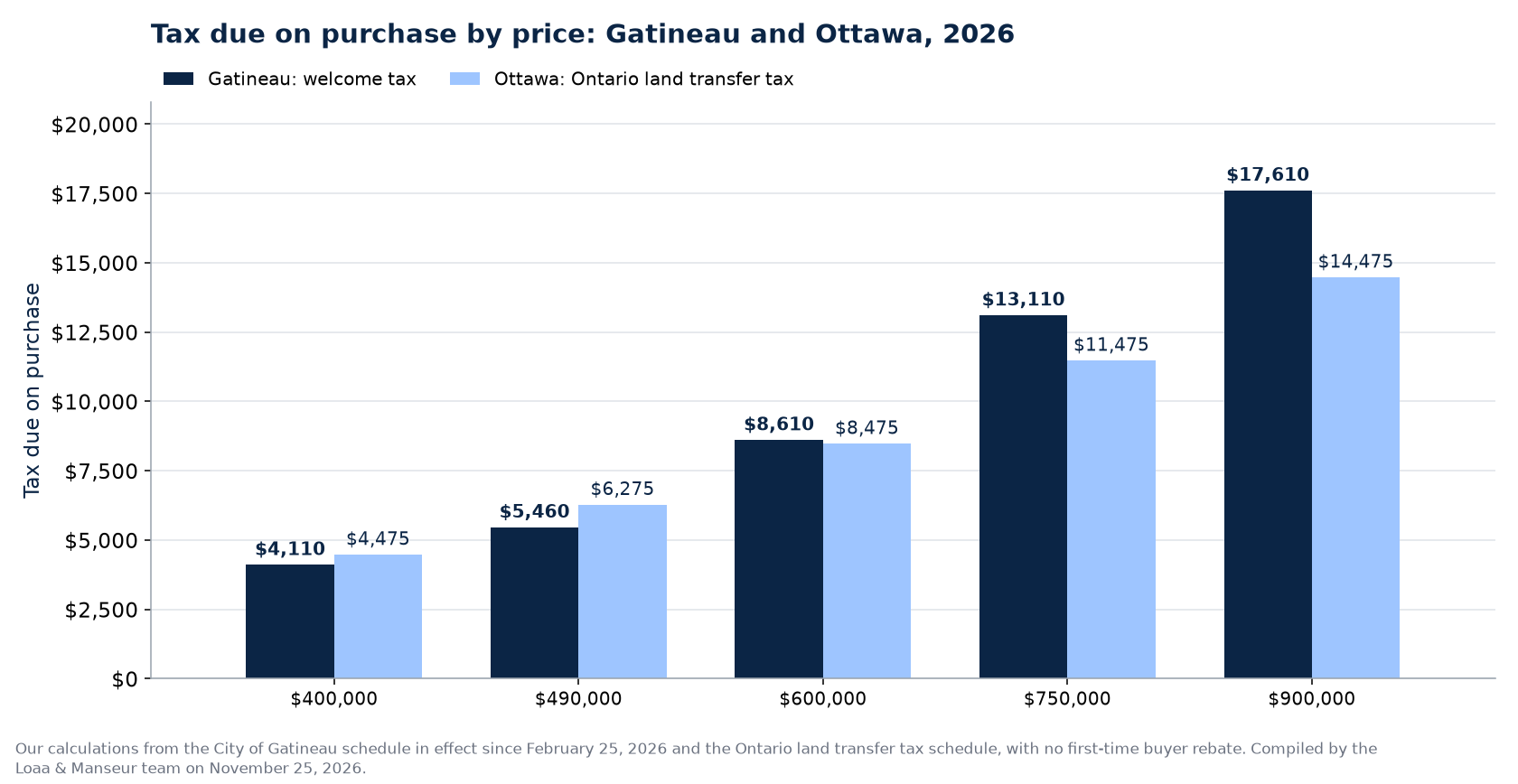
Since February 25, 2026, Gatineau charges a 3.0% welcome tax above $500,000 (City of Gatineau); Ontario charges 2.0% above $400,000 (province, April 22, 2026). By our team's calculation, with no rebates, a $490,000 purchase costs $5,460 in transfer tax in Gatineau and $6,275 in Ottawa; at $750,000, it is $13,110 versus $11,475. The tax bills published for 2026 are $3,575.15 in Gatineau (median residence) and $4,593 in Ottawa (average urban home), two different homes.
The short answer
Since February 25, 2026, Gatineau charges a 3.0% welcome tax above $500,000 (City of Gatineau); Ontario charges 2.0% above $400,000 (province, April 22, 2026). By our team's calculation, with no rebates, a $490,000 purchase costs $5,460 in transfer tax in Gatineau and $6,275 in Ottawa; at $750,000, it is $13,110 versus $11,475. The tax bills published for 2026, $3,575.15 in Gatineau and $4,593 in Ottawa, are not for the same home.
Tax at purchase: Gatineau's welcome tax and Ontario's land transfer tax
Schedule of transfer duties posted by the City of Gatineau for February 25 to December 31, 2026:
- 0.5% on the portion up to $62,900;
- 1.0% from $62,900 to $315,000;
- 1.5% from $315,000 to $500,000;
- 3.0% on the portion above $500,000.
From January 1 to February 24, 2026, the 1.5% rate ran up to $750,000, followed by 2.5% up to $1,000,000 and 3.0% above that. The City publishes an example for an existing property bought for $550,000: $6,360.50 under the earlier schedule and $7,110.50 since February 25, 2026, or $750 more.
In Ottawa, only Ontario's land transfer tax applies: the municipal land transfer tax is specific to Toronto. The provincial schedule (page updated April 22, 2026) is 0.5% up to $55,000, 1.0% up to $250,000, 1.5% up to $400,000 and 2.0% above that (2.5% above $2,000,000 for one or two single-family residences).
| Purchase price | Gatineau: welcome tax | Ottawa: Ontario land transfer tax | Gap (Ottawa minus Gatineau) |
|---|---|---|---|
| $400,000 | $4,110 | $4,475 | +$365 |
| $490,000 | $5,460 | $6,275 | +$815 |
| $600,000 | $8,610 | $8,475 | −$135 |
| $750,000 | $13,110 | $11,475 | −$1,635 |
| $900,000 | $17,610 | $14,475 | −$3,135 |
This table is our team's calculation from the two 2026 schedules, with no rebate or credit. The tax is lower in Gatineau at $400,000 and $490,000, and lower in Ottawa at $600,000, $750,000 and $900,000: above $500,000, Gatineau charges 3.0% and Ontario charges 2.0%.
First-time buyers: what each province refunds
Since 2026, Quebec has offered a refundable tax credit for home ownership (government news release and Ministère des Finances Information Bulletin 2026-2, April 17, 2026). It refunds 100% of the first $5,000 of transfer duties and 25% of the next $3,500, up to a maximum of $5,875. The home must be acquired after December 31, 2025, be worth less than $1,000,000 and become the principal place of residence no later than one year after the purchase. The credit shrinks by 2.35% of the part of the tax base that exceeds $750,000. The same news release mentions a non-refundable credit for the purchase of a first home, worth up to $1,400.
In Ontario, the province refunds up to $4,000 of land transfer tax to an eligible first-time buyer, so no tax is payable on the first $368,000 (page updated February 10, 2026). The buyer must be 18 or older and must never have owned a home anywhere in the world.
Municipal taxes: two published bills, two methods
| Example published by the city | Assessed value | 2026 tax bill | What is known for 2027 |
|---|---|---|---|
| Gatineau, median residence | $454,600 | $3,575.15 | +3.0% proposed on November 3, 2026, not adopted |
| Ottawa, average urban home | $415,000 | $4,593 | no draft budget tabled; cap of 2.5% promised by the mayor, according to CBC |
Gatineau's 2026 Budget breaks down the bill for a median residence assessed at $454,600, which comes to $3,575.15:
- residential category tax: $2,374.83;
- public transit: $644.17;
- debt service: $377.32;
- waste management: $178.83.
With the taxes tied to the former municipalities, the total ranges from $3,575.15 in Masson-Angers to $3,591.52 in Hull, a gap of $16.37. It is $3,581.57 in Aylmer, $3,583.33 in Buckingham and $3,584.68 in the Gatineau sector.
For 2027, the executive committee proposed a 3.0% residential increase on November 3, 2026. It has not been adopted, and the documents we read give no adoption date. The waste management charge would go from $178.83 to $182.43 per dwelling. No sample bill has been published for 2027.
In Ottawa, the 2026 budget approved on December 10, 2025 sets a net increase of 3.75%, or $166 more per year for the average urban or suburban homeowner (City news release). In the 2026 draft budget, the average urban home, assessed at $415,000, pays $4,593. For 2027, no draft budget has been tabled, since the municipal election was held on October 26, 2026. According to CBC (October 28 and November 5, 2026), the re-elected mayor promised to hold increases to 2.5% at most, and approval is expected in February 2027.
The two cities do not assess at the same date. Ottawa taxes values as of January 1, 2016, well below 2026 prices. In 2027, Gatineau moves to a roll based on the market as of July 1, 2025. So compare bills, not rates.
Gatineau's new 2027-2029 assessment roll
According to the City's news release of October 27, 2026, the new roll takes effect on January 1, 2027. The median value is $495,800 for a single-family home and $320,700 for a condo. The overall average change is 12.19%, phased in over three years.
The documents we read do not put a figure on what this rise in value does to the bill for a typical residence. What is established: the tax increase proposed for 2027 is 3.0%, and the effect of the roll varies from one property to the next. So the 2027 bill cannot be estimated by adding 3.0% to the 2026 bill.
New homes: HST in Ontario, GST and QST in Quebec
This section is about new construction: in Quebec, according to Revenu Québec, the sale of a home that is not new is exempt from these taxes. Based on CRA figures (2026), Ontario charges 13% HST (5% federal, 8% provincial) and Quebec charges 5% GST and 9.975% QST. The rebates on record:
- Federal, in both provinces: 36% of the GST, to a maximum of $6,300, and nothing at $450,000 or more (CRA, guide RC4028).
- Quebec: 50% of the QST, to a maximum of $9,975, and nothing at $300,000 or more (Revenu Québec).
- Ontario: 75% of the provincial part of the HST, to a maximum of $24,000, whatever the value of the home (CRA).
- First new home, federal: measure in force, royal assent on March 13, 2026; up to $50,000 of GST, full up to $1,000,000, nothing at $1,500,000 (CRA, June 16, 2026).
- First new home, Ontario: up to $80,000 of the provincial part, for a purchase agreement signed on or after March 20, 2025 and before 2031; available, according to the CRA.
- Ontario, temporary measure: up to $130,000 of HST for any eligible buyer of a new home purchased from a builder between April 1, 2026 and March 31, 2027 (Ontario's 2026 fall economic statement).
No QST rebate reserved for first-time buyers was found in Quebec.
Buying rules that change when you cross the river
In Quebec, article 2693 of the Civil Code requires an immovable hypothec, the Quebec term for a mortgage on real estate, to be granted by notarial act, on pain of absolute nullity: a notary is involved whenever there is a mortgage loan. According to the OACIQ, the promise to purchase sets the date for signing the deed of sale before a notary, and the notary's fees are paid by the buyer unless otherwise agreed. The seller must provide a certificate of location that describes the current state of the property, both physical and legal. Finally, Quebec real estate brokers must use the OACIQ's mandatory forms, including the promise to purchase.
How to read these numbers
- Gatineau's 2027 schedule of transfer duties was not posted as of November 25, 2026.
- Gatineau's bill includes public transit, but not the school tax. Ottawa's document does not say whether its amount includes the education portion.
- No property tax rate is quoted for Ottawa: the 2026 rate was not read at the official source.
- The lawyer's role in Ontario was not read at an official source, so we do not describe it.
For your own situation, consult a notary, an accountant, Revenu Québec or the city concerned.
The other pages in this series: Ottawa or Gatineau: where to buy, home prices, Ottawa vs Gatineau, income tax, Quebec vs Ontario, cost of living, living in Gatineau and working in Ottawa. See also: houses for sale in Gatineau, Gatineau property taxes in 2026, home prices in Aylmer, the Aylmer market, quarter by quarter, moving from Ontario to Quebec, Montréal vs Ottawa.
Frequently asked questions
How much is the welcome tax in Gatineau in 2026?
Since February 25, 2026, the City charges 0.5%, 1.0% and 1.5% by bracket up to $500,000, then 3.0% above that. Its example at $550,000 comes to $7,110.50. Our team calculates $5,460 on a $490,000 purchase, with no rebates.
Is the welcome tax refunded to first-time buyers in Gatineau?
Yes, in part or in full. Since 2026, Quebec's tax credit for home ownership refunds 100% of the first $5,000 of transfer duties and 25% of the next $3,500, up to $5,875, according to the Ministère des Finances.
Are municipal taxes lower in Gatineau than in Ottawa?
The examples published by the two cities for 2026 show $3,575.15 for Gatineau's median residence and $4,593 for Ottawa's average urban home. These are not the same homes or the same assessment dates, so the gap does not apply to your address.
Do you need a notary to buy a home in Gatineau?
Yes, whenever there is a mortgage: article 2693 of the Civil Code of Québec requires a notarial act. According to the OACIQ, the deed of sale is signed before a notary, and the notary's fees fall to the buyer unless otherwise agreed.
Sources: City of Gatineau (duties on transfers of immovables, 2026 schedules; 2026 Budget; 2027 budget proposal of November 3, 2026; news release of October 27, 2026); Government of Quebec and Ministère des Finances (news release and Information Bulletin 2026-2 of April 17, 2026); Ontario (land transfer tax, April 22, 2026; refunds for first-time homebuyers, February 10, 2026; 2026 fall economic statement); City of Ottawa (2026 draft budget; news release of December 10, 2025); CBC (October 28 and November 5, 2026); CRA (2026 rates; guide RC4028; page dated June 16, 2026); Revenu Québec (new housing); Civil Code of Québec, article 2693; OACIQ. Figures collected on November 25, 2026.
Our proof, not our promises
The Loaa & Manseur team, led by Lotfi Manseur and Loaa Al Daow, is the number 1 team at RE/MAX Platine in 2024 and 2025, 6th RE/MAX team in Quebec, 15th in Canada and in the global top 50 of large residential teams according to the official RE/MAX ranking, computed on actual transactions. Its Google profile counts more than 220 reviews with a 4.9 rating. Its offices are at 55 avenue de l'Équinoxe in Brossard, one bridge from the island, and every broker's licence can be checked in the OACIQ public register. Three things to verify yourself before calling us, and to demand of any other broker.
Also available in French: version française de ce guide.
Published September 7, 2026 by the Loaa & Manseur team, the number 1 team at RE/MAX Platine in 2024 and 2025, 6th RE/MAX team in Quebec, 15th in Canada and in the global top 50 according to the official RE/MAX ranking. Tell us about your project.