Selling · Montréal · vacant home tax
Montréal announced on November 26, 2026 that it wants to tax vacant homes. Here is who is targeted, what Quebec law allows, what remains to be decided and what an empty unit could cost.
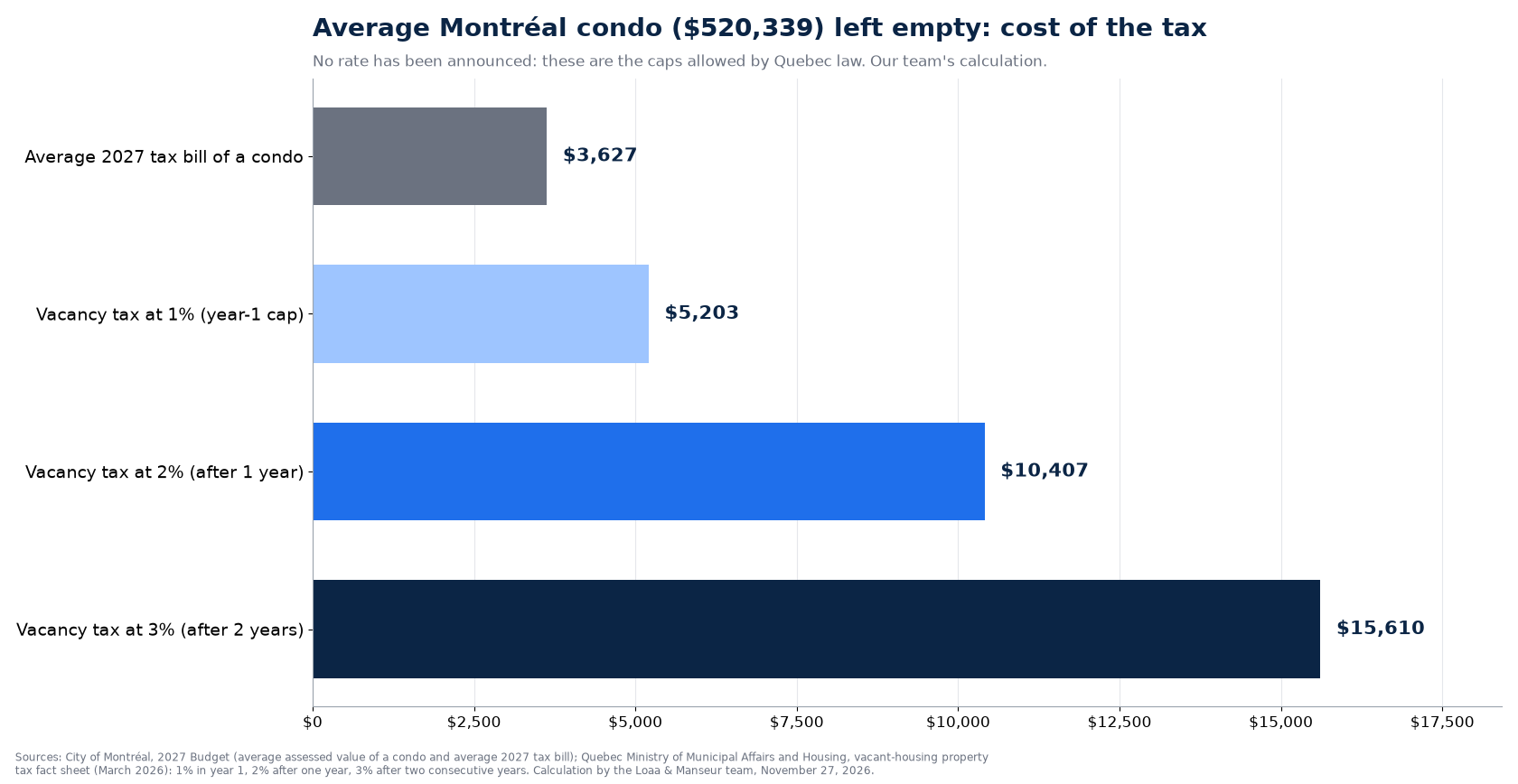
Montréal wants to tax vacant homes, but this is an intention, not a rule. Nothing has been adopted yet in Montréal: there is no by-law, no rate and no start date. On November 26, 2026, Caroline Braun, the executive committee member responsible for housing, said the administration of Mayor Soraya Martinez Ferrada wants this tax, in particular for buildings emptied by their owners to raise rents, according to La Presse. Quebec law has allowed it since December 2023: a dwelling not occupied at least 180 days a year can be taxed, at a rate capped at 1% of the property value in the year the tax is introduced, 2% once the City has imposed it for at least one year and 3% once it has imposed it for at least two consecutive years. For the average Montréal condo left empty all year, that would mean $5,203 at 1%, according to our team's calculation, on hypothetical rates. Sources: La Presse, Ministère des Affaires municipales et de l'Habitation, Cities and Towns Act and City of Montréal 2027 budget, read on November 27, 2026.
The short answer
Montréal wants to tax vacant homes, but this is an intention, not a rule. Nothing has been adopted yet in Montréal: there is no by-law, no rate and no start date. On November 26, 2026, Caroline Braun, the executive committee member responsible for housing, said the administration of Mayor Soraya Martinez Ferrada wants this tax, in particular for buildings emptied by their owners to raise rents, according to La Presse. Quebec law has allowed it since December 2023: a dwelling not occupied at least 180 days a year can be taxed, at a rate capped at 1% of the property value in the year the tax is introduced, 2% once the City has imposed it for at least one year and 3% once it has imposed it for at least two consecutive years. For the average Montréal condo left empty all year, that would mean $5,203 at 1%, according to our team's calculation, on hypothetical rates.
What was announced on November 26, 2026
The announcement came from Caroline Braun, who is responsible for housing on the executive committee and is also mayor of the Outremont borough. She spoke on the sidelines of a municipal commission at city hall, on Thursday, November 26, 2026, as reported by La Presse.
- What is targeted: in particular, buildings that owners empty in order to raise the rents. The administration also has speculation and large owners in its sights.
- What is not targeted: the owner who keeps the second-floor unit for a son or a grandson, or the owner who needs three months to find a tenant.
- When: she wants the tax as soon as possible, but no date and no rate were announced.
- What officials are studying: city staff have a mandate to analyze how to put it in place, in particular the criteria that define a vacant dwelling and how to prove a vacancy before a court. The housing department (Service de l'habitation) is looking at whether new inspectors are needed or whether the existing squads, for sanitation and for Airbnb, can do the work.
The idea also has the support of the opposition: last summer, city council unanimously adopted a motion from the Official Opposition asking that the question be studied.
An idea Montréal has looked at before
In 2023, the previous administration had mentioned it among its budget options, according to La Presse at the time. Quebec law has allowed it since December 2023, but Montréal has never adopted a by-law, Journal Métro notes. The announcement comes as the 2027 budget raises the residential tax burden by 9.8% on average: see the Montréal property tax increase for 2027 and the 2027 increases in the linked cities.
What Quebec law already allows
The framework comes from Bill 39, assented to on December 8, 2023, which added sections 500.5.1 to 500.5.3 to the Cities and Towns Act (and the equivalent articles of the Municipal Code). Buildings owned by the government are exempt.
| Rule | What Quebec law provides |
|---|---|
| What is taxed | The property value of a building that has at least one vacant or underused dwelling. Only dwellings are targeted, not commercial premises. |
| Vacant or underused | Not occupied at least 180 days a year by the owner, by a relative, an in-law (including through a de facto spouse) or a person in a caregiving relationship with the owner, or by a tenant or subtenant under a lease of at least 180 days. |
| Rate | At the City's discretion, without exceeding 1% the first year, 2% after one year and 3% after two consecutive years of the tax. The rate can vary by criteria, for example by sector. |
| Base, one dwelling | The value of the assessment unit. |
| Base, 2 dwellings or more | The value × (vacant dwellings ÷ total dwellings). In a mixed building, only the residential part. |
| Tourist residences | Taxed, even when that part of the building is classified as non-residential. |
| Collection | On the tax bill. The revenue goes to the general fund or to a dedicated fund, for example for social or community housing. |
One point is often misread: the 1%, 2% and 3% caps rise with the age of the tax in the municipality, not with the length of the vacancy. The details of who escapes the tax: the 180-day rule and the exemptions.
What Montréal still has to decide
- The rate, within the legal caps, possibly different by sector.
- The reference period: the ministry gives the example of the calendar year before the tax year, or a year that starts on July 1 to follow the leases.
- Additional exemptions, for example for a property transferred during the reference year, and whether to require a longer vacancy (such as 200 days) or to add up several leases totalling 180 days.
- How vacancy will be established: the City chooses the means, and can require an annual self-declaration from every residential owner.
The process has four steps: a draft by-law, a notice of motion with the tabling of the draft, adoption at a later sitting (at the earliest on the second day after), then coming into force on publication or later.
What it could cost
At the 1% cap, the average condo on Montréal's 2027 roll ($520,339) left empty all year would pay $5,203 of vacancy tax, more than its average 2027 tax bill of $3,627. For an average duplex with one empty unit, the tax would apply to half the value: $4,355 at 1%. These amounts are our team's calculation, on hypothetical rates, since Montréal has announced none. The full table: calculation examples at 1%, 2% and 3%.
You have an empty unit today: what to do now
- Check whether the unit reaches 180 days of occupancy in the year, by you, a family member or a tenant with a lease of at least 180 days.
- Keep the leases, the dates and the documents that show who lives there: if the City requires a declaration, supporting documents can be asked for.
- If the unit is under major work, note the start and end dates: the law deems it occupied during the work and for 6 months after, up to 24 months from the start.
For plex owners: an empty unit in a Montréal plex. This page informs you: it is not legal or tax advice. The rules that will apply are those of the by-law, once Montréal adopts one; for your situation, see your notary or your accountant.
The six guides in this series
- How much would it cost: calculation examples
- Who would not pay: the 180-day rule and the exemptions
- Plex owner with an empty unit
- Buying a plex with a vacant unit in Montréal
- Second home, pied-à-terre and Airbnb
- Montréal compared with Toronto, Vancouver and Ottawa
Frequently asked questions
Has Montréal adopted a vacant home tax?
No. On November 26, 2026, the administration announced that it wants one, but there is no by-law, no rate and no start date yet. City staff are studying how to put it in place.
Who would pay the Montréal vacant home tax?
The owner of a building with at least one dwelling not occupied 180 days a year, under Quebec law. The City says it is targeting in particular buildings emptied to raise rents, speculation and large owners.
How much could the tax be?
Quebec law caps it at 1% of the property value the first year, 2% after one year and 3% after two consecutive years. For the average Montréal condo empty all year, that is $5,203 at 1%, according to our team's calculation, on hypothetical rates.
Would a unit empty for three months between two tenants be taxed?
According to La Presse, the City says it is not targeting an owner who takes three months to find a tenant. Under the law, a unit rented under a lease of at least 180 days in the year is not vacant. The final rules will be those of the by-law.
Would a unit kept for my son be taxed?
Under the law, a dwelling occupied at least 180 days a year by a relative of the owner is not vacant, and the City says it is not targeting this case.
Sources: La Presse, article by Philippe Teisceira-Lessard on Montréal's plan to tax vacant homes, November 26, 2026; La Presse (2023) and Journal Métro on the earlier study of the idea; Ministère des Affaires municipales et de l'Habitation, fact sheet on the property value tax on vacant dwellings (March 2026) and Muni-Express bulletin no. 11 of December 21, 2023; Cities and Towns Act, sections 500.5.1 to 500.5.3, and Municipal Code, articles 1000.5.1 to 1000.5.3 (Bill 39, assented to on December 8, 2023); City of Montréal, 2027 budget, average values on the roll by type of property. Read on November 27, 2026.
Our proof, not our promises
The Loaa & Manseur team, led by Lotfi Manseur and Loaa Al Daow, is the number 1 team at RE/MAX Platine in 2024 and 2025, 6th RE/MAX team in Quebec, 15th in Canada and in the global top 50 of large residential teams according to the official RE/MAX ranking, computed on actual transactions. Its Google profile counts more than 220 reviews with a 4.9 rating. Its offices are at 55 avenue de l'Équinoxe in Brossard, one bridge from the island, and every broker's licence can be checked in the OACIQ public register. Three things to verify yourself before calling us, and to demand of any other broker.
Also available in French: version française de ce guide.
Published September 7, 2026 by the Loaa & Manseur team, the number 1 team at RE/MAX Platine in 2024 and 2025, 6th RE/MAX team in Quebec, 15th in Canada and in the global top 50 according to the official RE/MAX ranking. Tell us about your project.