Buying · Montréal · vacant home tax
Toronto, Vancouver and Ottawa already tax vacant homes. Here are their rates, their rules and their results, set against the limits Quebec law imposes on the tax Montréal wants to adopt.
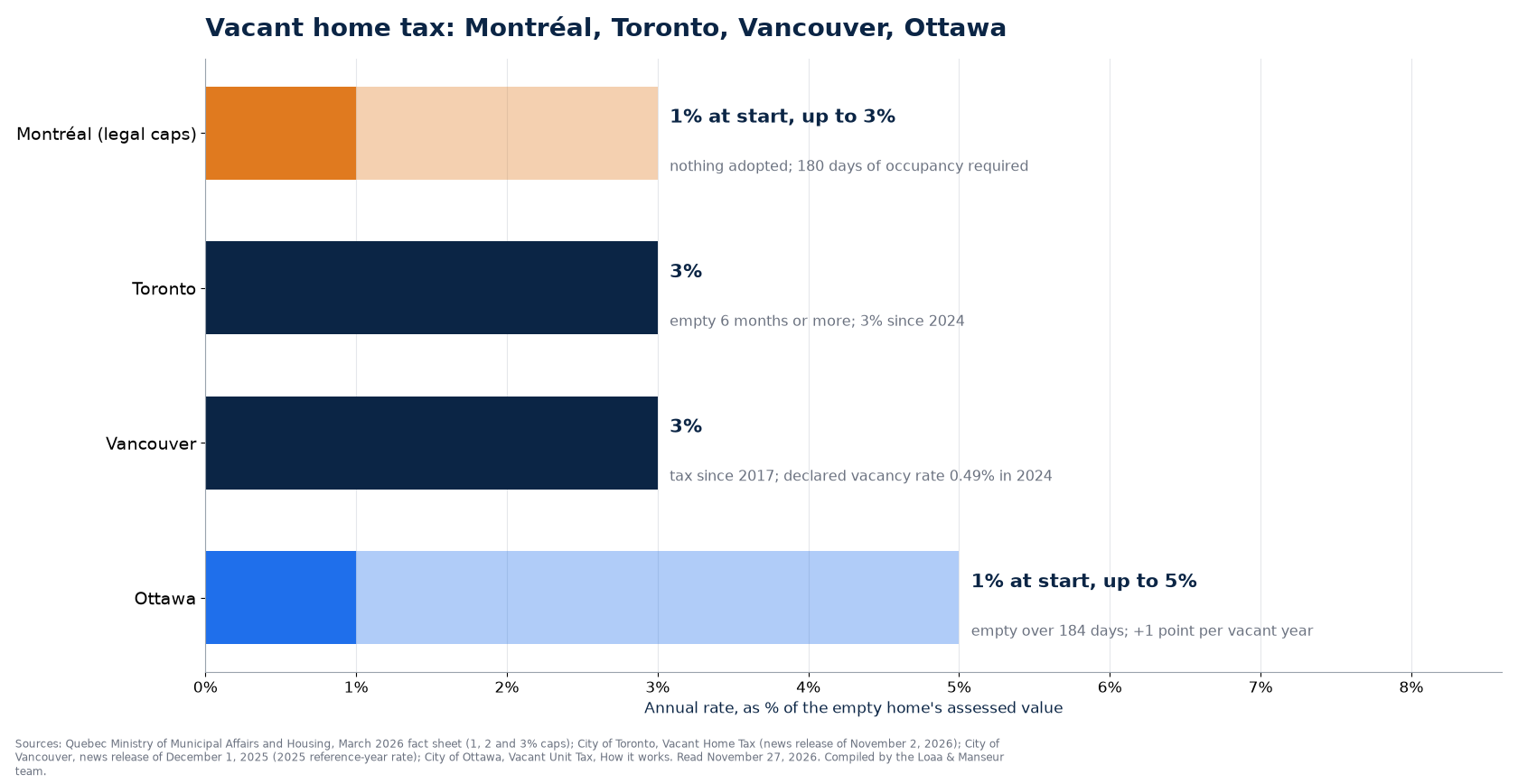
Nothing has been adopted yet in Montréal: there is no by-law, no rate and no start date. Quebec law caps the rate at 3% of the property value, the same level as Toronto since 2024 and Vancouver for the 2025 reference year, while Ottawa goes up to 5% for a home left vacant several years in a row. The vacancy thresholds differ: 180 days a year under Quebec law, six months or more in Toronto, more than 184 days in Ottawa. In Vancouver, the reported vacancy rate fell to a record 0.49% for 2024, and the tax has paid $194.3 million to affordable housing since 2017. The federal Underused Housing Tax is abolished starting with the 2025 year, which does not affect municipal taxes. Sources: Cities of Toronto, Vancouver and Ottawa, Ministère des Affaires municipales et de l'Habitation and La Presse, read on November 27, 2026.
The short answer
Nothing has been adopted yet in Montréal: there is no by-law, no rate and no start date. Quebec law caps the rate at 3% of the property value, the same level as Toronto since 2024 and Vancouver for the 2025 reference year, while Ottawa goes up to 5% for a home left vacant several years in a row. The vacancy thresholds differ: 180 days a year under Quebec law, six months or more in Toronto, more than 184 days in Ottawa. In Vancouver, the reported vacancy rate fell to a record 0.49% for 2024, and the tax has paid $194.3 million to affordable housing since 2017. The federal Underused Housing Tax is abolished starting with the 2025 year, which does not affect municipal taxes.
The four cities side by side
| City | Maximum rate | When a home is vacant | Who must declare | Results reported |
|---|---|---|---|---|
| Montréal | Nothing adopted. Quebec cap: 1%, then 2%, then 3% | Not occupied at least 180 days a year (Quebec law) | The City may require an annual self-declaration from all residential owners | No results yet: no by-law |
| Toronto | 3% of the assessed value since 2024 (1% before) | Unoccupied six months or more in the previous calendar year | All residential owners, even for a principal residence | 6,944 homes deemed vacant for 2022; about $105 million estimated for 2024 |
| Vancouver | 3% for the 2025 reference year | Not stated in the City release we read | All owners, every year | Vacancy rate of 0.49% for 2024 (0.90% in 2017); $194.3 million to affordable housing since 2017 |
| Ottawa | 1% the first year, plus 1 point per consecutive year, up to 5% | Unoccupied more than 184 days in the previous calendar year | Declaration due by the third Thursday of March | Not covered by our sources |
Sources: the official sites of the three cities and the Quebec ministry. The Toronto figures for 2022 come from CTV; the revenue for 2024 is the City's estimate.
Toronto: 3% and a declaration for everyone
Toronto taxes a vacant home at 3% of its assessed value since 2024; the rate was 1% before, and council voted in 2023 to raise it. A home is vacant if it was unoccupied six months or more during the previous calendar year. Every residential owner must declare, even for a principal residence: the declaration for 2026 is due no later than Friday, April 30, 2027. A property with no declaration is deemed vacant, and a false declaration can bring a fine of up to $10,000. For 2022, 6,944 homes were deemed vacant, and the City estimated its revenue at about $105 million for 2024.
Vancouver: the oldest, since 2017
Vancouver's Empty Homes Tax has existed since 2017. Its rate is 3% of the property value for the 2025 reference year. The City reports a record low vacancy rate of 0.49% for 2024, against 0.90% in 2017, with fewer than 1,000 vacant homes for the first time, and $194.3 million paid to affordable housing since 2017. Every owner must declare each year, and a late declaration costs $250. This municipal tax is separate from the British Columbia speculation and vacancy tax.
Ottawa: a rate that climbs each year
Ottawa charges 1% of the assessed value for the first year of vacancy, then adds 1 point for each consecutive year, up to 5%. After a year of occupancy, the rate goes back to 1%. A unit is vacant if it was unoccupied more than 184 days during the previous calendar year. The declaration is due by the third Thursday of March: March 19, 2026 for the 2025 year.
Montréal: what Quebec law already sets
In Montréal, it is only a project announced on November 26, 2026. Quebec law, however, already fixes its limits: 180 days of occupancy, a rate capped at 1% the year the tax is introduced, 2% after one year and 3% after two consecutive years, and a base limited to the share of the empty units in a plex. Unlike Ottawa, the Quebec cap rises with the age of the tax in the municipality, not with the length of the vacancy. On the penalty side, the law allows a penalty equal to the tax for an omission or a false declaration. The details: what we know about the Montréal project and the exemptions.
In 2025, according to the Quebec ministry, the tax existed in Toronto, Hamilton, Ottawa, Windsor, Sault Ste. Marie and Vancouver. No Quebec city appears on that list.
The federal tax is gone, not the municipal ones
The federal Underused Housing Tax is abolished starting with the 2025 year, following the federal budget of November 4, 2025 and the act assented to on March 26, 2026. It still applies to the 2022 to 2024 years. The abolition does not affect municipal or provincial taxes.
For a buyer comparing the cities
On the same average Montréal condo ($520,339 on the 2027 roll) left empty all year, a 3% rate like Toronto's or Vancouver's would mean $15,610, according to our team's calculation, on hypothetical rates. To compare the markets themselves: Montréal vs Toronto, Montréal vs Vancouver and Montréal vs Ottawa. This page informs you: it is not legal or tax advice. The rules that will apply are those of the by-law, once Montréal adopts one; for your situation, see your notary or your accountant.
Frequently asked questions
What is the vacant home tax rate in Toronto?
3% of the assessed value since 2024, after 1% before. A home is vacant if it was unoccupied six months or more in the previous calendar year.
Has Vancouver's Empty Homes Tax worked?
The City reports a vacancy rate of 0.49% for 2024, against 0.90% in 2017, and $194.3 million paid to affordable housing since 2017.
Could Montréal charge 5% like Ottawa?
No. Quebec law caps the rate at 3%, and only after two consecutive years of the tax. Montréal has not adopted any rate.
Does the federal Underused Housing Tax still apply?
It is abolished starting with the 2025 year, but still applies to the 2022 to 2024 years. Its abolition does not affect municipal taxes.
Sources: City of Toronto, Vacant Home Tax page and news release of November 2, 2026; CTV News and Global News on the 2023 council vote; City of Vancouver, Empty Homes Tax news release of December 1, 2025; City of Ottawa, vacancy tax page "How it works"; Federal budget of November 4, 2025 and the act assented to on March 26, 2026 (Underused Housing Tax); Ministère des Affaires municipales et de l'Habitation, fact sheet on the property value tax on vacant dwellings (March 2026) and Muni-Express bulletin no. 11 of December 21, 2023; La Presse, article by Philippe Teisceira-Lessard on Montréal's plan to tax vacant homes, November 26, 2026. Read on November 27, 2026.
Our proof, not our promises
The Loaa & Manseur team, led by Lotfi Manseur and Loaa Al Daow, is the number 1 team at RE/MAX Platine in 2024 and 2025, 6th RE/MAX team in Quebec, 15th in Canada and in the global top 50 of large residential teams according to the official RE/MAX ranking, computed on actual transactions. Its Google profile counts more than 220 reviews with a 4.9 rating. Its offices are at 55 avenue de l'Équinoxe in Brossard, one bridge from the island, and every broker's licence can be checked in the OACIQ public register. Three things to verify yourself before calling us, and to demand of any other broker.
Also available in French: version française de ce guide.
Published September 7, 2026 by the Loaa & Manseur team, the number 1 team at RE/MAX Platine in 2024 and 2025, 6th RE/MAX team in Quebec, 15th in Canada and in the global top 50 according to the official RE/MAX ranking. Tell us about your project.